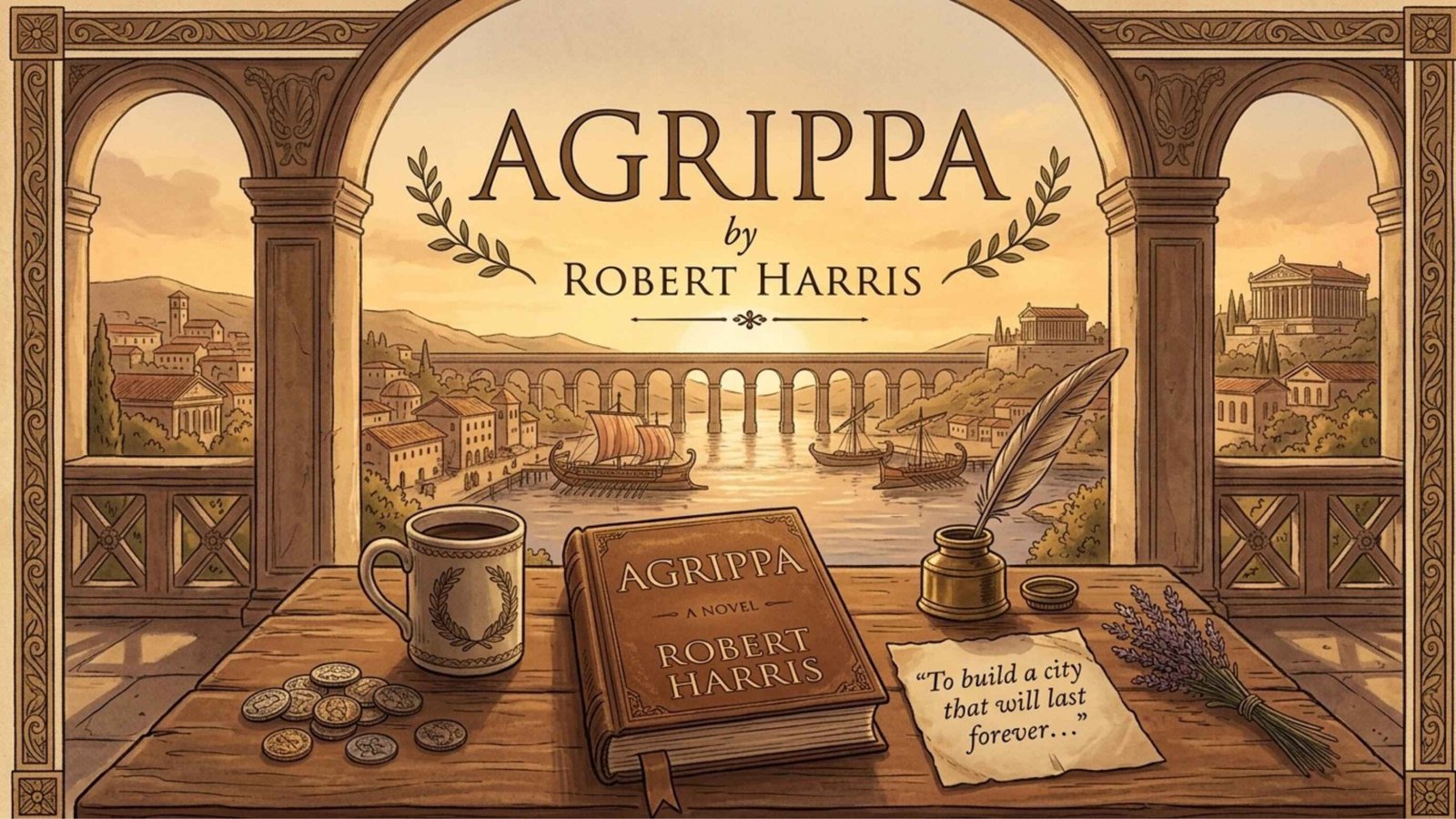
Agrippa
by Robert Harris — Book Club Discussion Guide
Julius Caesar has just been murdered, and two teenage boys are about to be swept into the fight for his inheritance: his seventeen-year-old great-nephew Octavius, and Octavius’s closest friend, a quietly formidable commoner named Marcus Agrippa. Against the odds, they win. Octavius becomes the Emperor Augustus, and for the next forty years Agrippa is the man beside him — general, admiral, engineer, and fixer — the power behind the throne that history mostly forgot. Now Agrippa is fifty, ailing, and reeling from his wife’s infidelity. Alone at his house on the Bay of Naples, he sits down to write his memoirs. Told entirely in Agrippa’s own voice, this is Robert Harris on classic form: political intrigue, naval warfare, and one enormous question running underneath it all — when it comes to power, does friendship exist?
Disclosure: This post may contain affiliate links to Amazon. If you buy through them, I may earn a small commission at no extra cost to you.

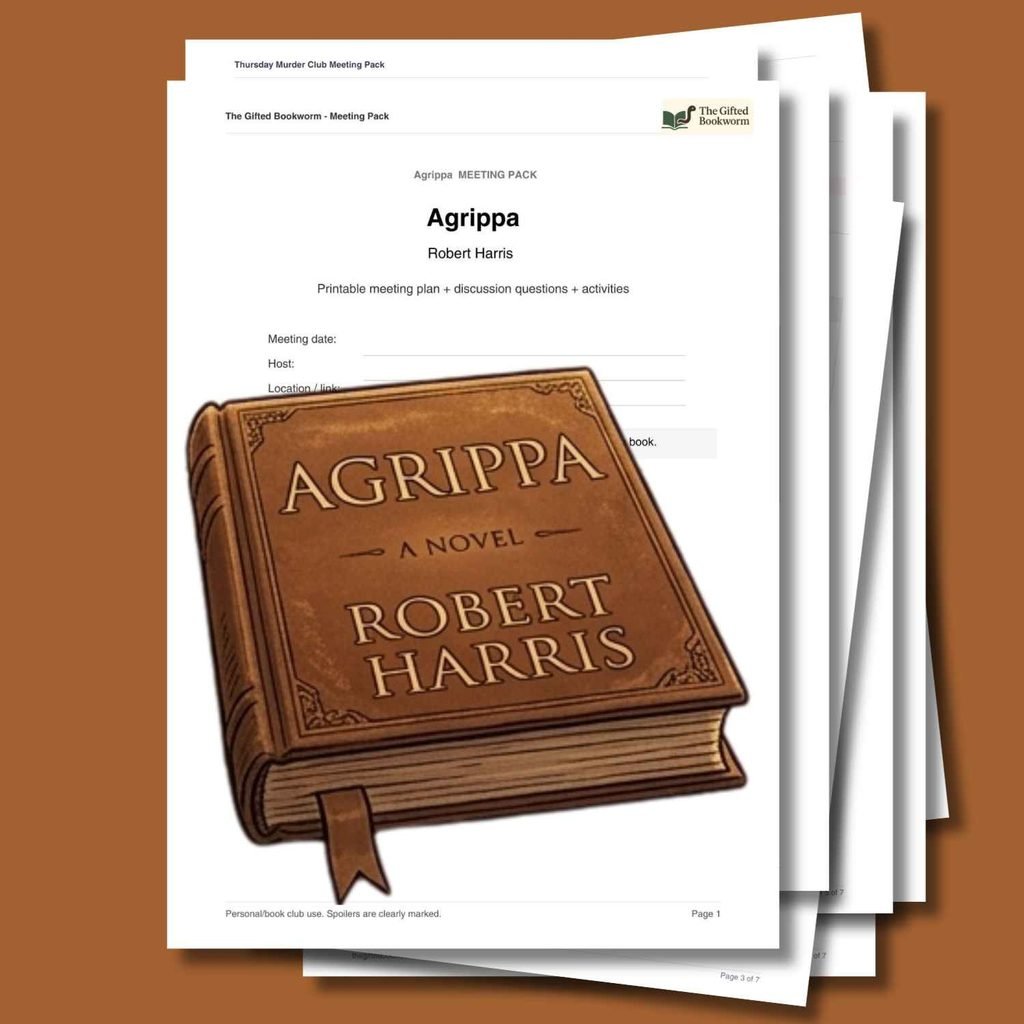
What’s inside (6 pages): cover sheet, welcome + content note, quick guide/characters/themes, meeting plan, spoiler-free questions, spoiler zone, mini activity (“Twenty Years at Caesar’s Side”), ratings + next-month vote.
Quick character cheat sheet
- Marcus Agrippa — our narrator; a plebeian outsider and the son of a Stoic, who rises through sheer competence to become the second most powerful man in Rome, without ever quite becoming his friend’s equal.
- Octavius / Augustus — Caesar’s teenage heir, and Agrippa’s oldest friend; cunning, patient, and increasingly unknowable as absolute power reshapes him.
- Julius Caesar — the dictator whose assassination sets the whole story in motion.
- Mark Antony — Caesar’s former lieutenant and Octavius’s great rival, allied with Cleopatra against him.
- Cleopatra — Queen of Egypt, Antony’s ally and the woman standing between Octavius and total control of Rome.
- Julia — Agrippa’s wife and Augustus’s daughter; her infidelity is the wound that pushes Agrippa to start writing.
Themes to watch
Friendship versus power, and whether the two can ever coexist • loyalty and its limits • the commoner who out-works the aristocrat • memoir and memory: what we choose to tell and what we leave out • ambition’s cost to marriage and family • how a republic slides into a dictatorship, one “necessary” decision at a time.
This book touches on war and battlefield violence, political assassination, infidelity, and the erosion of a democratic republic. Please take care, and skip any questions your group doesn’t want to cover.
Discussion questions
Spoiler-free
- Describe the book in three words — then compare answers.
- The novel is framed as Agrippa’s own memoir, written near the end of his life. How did that first-person, looking-back structure shape the way you experienced the story?
- Agrippa and Octavius meet as teenagers and their friendship carries the whole book. What did you make of Agrippa’s devotion to him, even early on?
- Harris opens with Agrippa ailing and betrayed, then rewinds across forty years. Did knowing where he ends up change how you read his younger self?
- Agrippa is a commoner among aristocrats for his entire career. Where did you see that outsider status help him — and where did it clearly cost him?
- The book’s subtitle points to Rome’s “descent into dictatorship.” Which moment felt like the real turning point to you?
- Several reviewers have described this as reading like the “minutes” of an extraordinary life rather than a dramatised retelling of it. Did the restrained, matter-of-fact voice work for you, or did you want more scene and less summary?
- Agrippa was also the engineer behind aqueducts and harbours (he appears in this way in Harris’s earlier novel Pompeii). Why do you think Harris chose to centre a builder and organiser, rather than a more obviously glamorous figure, as his narrator?
- What did you make of Octavius/Augustus as Harris portrays him — sympathetic, chilling, or somewhere in between?
- Who would you recommend this book to?
Spoiler zone
STOP HERE if anyone hasn’t finished the book.
- Agrippa begins writing after discovering his wife Julia’s infidelity. How did that private, domestic betrayal sit against the vast public power he’d spent his life building?
- A real rift opens between Agrippa and Augustus once Augustus effectively claims Agrippa’s son as his own heir. How did you feel about the way Harris handles that shift in their friendship?
- By the end, does the novel suggest Agrippa and Octavius were ever truly friends — or was it always a working alliance dressed up as one?
- The book closes with Agrippa’s legacy folded into the dynasty he helped create — a line that, through Julia, eventually produces Caligula and, later, Nero. What did that final perspective add to the story for you?
- How does Actium — the naval battle Agrippa masterminded against Antony and Cleopatra — function in the book: as a triumph, a turning point, or something more ambiguous?
- What do you think the novel is ultimately arguing about power — that it corrupts even the most decent people, or that decency was never really the point?
Meeting plan (60–90 minutes)
- 0–10: Warm-up (3-word vibe / would you rather be the emperor or the indispensable right-hand?)
- 10–50: Spoiler-free discussion
- 50–70: Spoiler zone (optional)
- 70–80: Mini activity: Twenty Years at Caesar’s Side
- 80–90: Ratings + vote for next month
Mini activity: Twenty Years at Caesar’s Side
On a shared timeline (or scrap paper each), have everyone plot the three moments they think mattered most in Agrippa and Octavius’s forty-year partnership — one triumph, one cost, and one moment of doubt. Compare timelines: does the group agree on where the friendship actually broke down, or does everyone point to a different scene?
Ratings + next month
Rate Agrippa out of 5 🏛️ — then vote on next month’s pick together.